
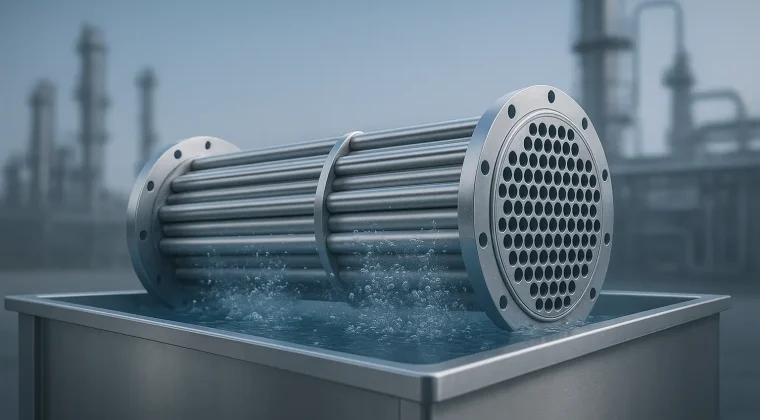
When maintenance leaders compare cleaning approaches for shell-and-tube equipment, the biggest performance wins increasingly come from adopting industrial ultrasonic heat exchanger cleaning machines that remove heavy fouling while using far less water and enabling faster, more predictable turnarounds.
Less Water, More Throughput
In day-to-day operations, water logistics quietly dominate cost and coordination. High-pressure jetting needs a steady stream of water, operators, and staging; change any variable and schedules slip. With a purpose-built heat exchanger cleaning machine, the process shifts from continuous overspray to controlled cavitation in a closed tank, cutting water consumption, secondary waste, and cleanup time while freeing cranes and crews for other critical-path tasks.
Beyond the water math, the physics of cavitation improve consistency. Instead of chasing individual tubes with a lance, the ultrasonic field envelopes the part, so the cleaning action reaches complex geometries at once—tubesheets, baffles, and crevices that are tedious or inconsistent with manual jetting.
Fewer reworks, fewer surprises, and a steadier cadence through the outage raise throughput without adding bodies or hours. The setup also simplifies containment and housekeeping, keeping nearby workfaces productive rather than pausing for overspray.
28 kHz Cavitation for Faster Heat-Transfer Recovery
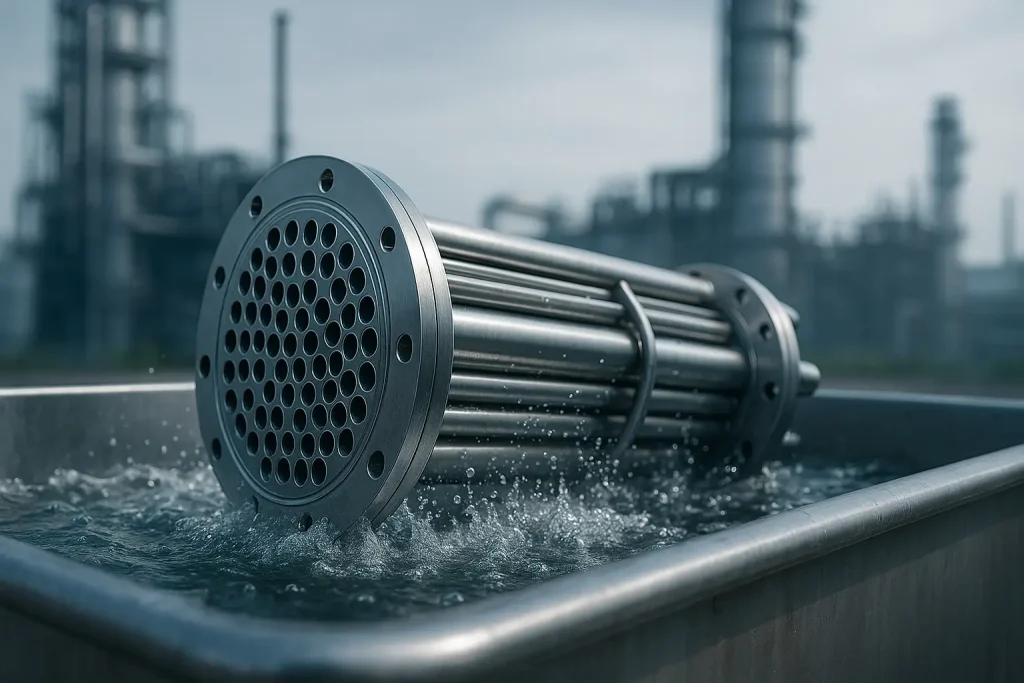
The most practical reason teams standardize on ultrasonics is that heat-transfer comes back quickly after restart. Synchronized, low-frequency waves at 28 kHz generate dense cavitation that targets bonded deposits—scale, polymers, and coke—without attacking base metal. With 28 kHz ultrasonic cavitation technology, energy density stays uniform across large stainless tanks, so bundles clean evenly in repeatable cycles and return to design duty with fewer corrective stops during the first days on stream.
That repeatability pays off in ways that matter to operations: more stable pressure drop across exchangers, fewer hot spots, and less variability between shifts. Because the process is recipe-driven, you can document bath chemistry, temperature, time, and generator settings and reproduce the same outcome next time—no guesswork or reliance on a handful of specialist operators.
Plants use these recipes to standardize across units and sites, making results comparable and audit-ready. Inspection photos and post-clean test data become part of a routine handover package that engineering can review quickly.
From Planning to Execution in Turnarounds
Outages live or die on logistics, and ultrasonic systems were built with that reality in mind. Containerized units roll in, connect to utilities, and stage close to the pull area. During a planned shutdown, proven ultrasonic cleaning for Oil & Gas turnarounds let teams clean, inspect, and release exchangers back to service in a tight loop, maintaining crane cadence and avoiding idle time.
Because tanks operate in a closed environment, the work zone is tidier and easier to coordinate with other trades. Permit workflows and staging are simpler, with less rework due to water overspray or restricted access around active lancing.
The result is a critical path that feels controlled instead of chaotic. Your outage map becomes cleaner, and so does the schedule; teams can forecast with confidence and hit milestones without adding shifts or budget.
Where to See It Working Today
If you want proof beyond specifications, look for documented projects where ultrasonics stabilized restart and shortened the learning curve. Browse our ultrasonic heat exchanger cleaning case studies covering crude preheat trains, condensers, reboilers, fin-fan spares, demisters, and valve bodies.
Those examples show the operational detail that matters: where the tank was staged, how cranes were scheduled, which recipes fit which fouling types, and how inspection sign-off was structured to keep reinstatement moving.
A Simpler Path to Better Performance
Ultrasonic cleaning streamlines the maintenance loop: less water to manage, less waste to handle, steadier throughput of bundles, and faster recovery of design heat-transfer. By shifting the bottleneck away from operators and water supply toward a controlled, recipe-driven process, you increase the certainty of the schedule and the quality of the outcome—two levers every turnaround manager wants on their side.
If your goal is to deliver more production days per year with the same people and the same footprint, the calculus is straightforward. Move away from variability and toward repeatability. Reduce the resource burden and increase measurable output. In short: clean smarter, not harder—and do it with ultrasonics.